
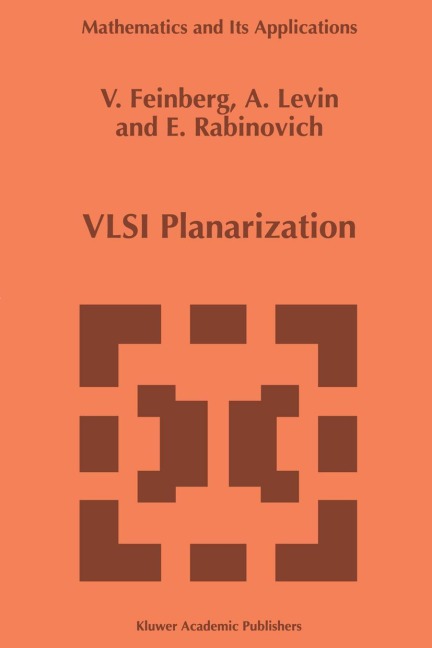
VLSI Planarization: Methods, Models, Implementation - E B Rabinovich,A G Levin,V Z Feinberg
-25% su kodu BOOKS
Pristatymas per 22-28 d.d.
30 dienų grąžinimo politika
At the beginning we would like to introduce a refinement. The term 'VLSI planarization' means planarization of a circuit of VLSI, Le. the embedding of a VLSI circuit in the plane by different criteria such as the minimum number of connectors, the minimum total length of connectors, the minimum number of over-the-element routes, etc. A connector is designed to connect the broken sections of a net. It can be ... Visas aprašymas
Jums taip pat gali patikti
 TOP
TOP

Gödel, Escher, Bach: An Eternal Golden Braid
-25% su kodu BOOKS
Turime sandėlyje pas mūsų tiekėją
TOP

AI Engineering: Building Applications with Foundation Models
-25% su kodu BOOKS
Turime sandėlyje pas mūsų tiekėją
TOP
Empire of AI: Dreams and Nightmares in Sam Altman's OpenAI
-25% su kodu BOOKS
Turime sandėlyje pas mūsų tiekėją
TOP
The Pragmatic Programmer: journey to mastery, 20th Anniversary Edition, 2/e: your journey to mastery, 20th Anniversary Edition
-25% su kodu BOOKS
Turime sandėlyje pas mūsų tiekėją
TOP


The Rust Programming Language
Steve Klabnik, Carol Nichols, Chris Krycho
-25% su kodu BOOKS
Turime sandėlyje pas mūsų tiekėją
TOP

How Linux Works: What Every Superuser Should Know
-25% su kodu BOOKS
Turime sandėlyje pas mūsų tiekėją
TOP

How To Think About AI: A Guide For The Perplexed
-25% su kodu BOOKS
Turime sandėlyje pas mūsų tiekėją
TOP
The Art of Game Design: A Book of Lenses
-25% su kodu BOOKS
Turime sandėlyje pas mūsų tiekėją
TOP

Python Crash Course: A Hands-On, Project-Based Introduction to Programming
-25% su kodu BOOKS
Turime sandėlyje pas mūsų tiekėją
TOP

CompTIA Security+ Certification Kit: Exam SY0-701
-25% su kodu BOOKS
Turime sandėlyje pas mūsų tiekėją
TOP
Automate the Boring Stuff with Python
-25% su kodu BOOKS
Turime sandėlyje pas mūsų tiekėją
TOP
Fundamentals of Software Architecture: A Modern Engineering Approach
-25% su kodu BOOKS
Turime sandėlyje pas mūsų tiekėją
TOP

Speak Data: Artists, Scientists, Thinkers, and Dreamers on How We Live Our Lives in Numbers
-25% su kodu BOOKS
Turime sandėlyje pas mūsų tiekėją
TOP

Hacking: The Art of Exploitation
-25% su kodu BOOKS
Turime sandėlyje pas mūsų tiekėją
TOP

Hackers. 25th Anniversary Edition: Heroes of the Computer Revolution
-25% su kodu BOOKS
Turime sandėlyje pas mūsų tiekėją
TOP

Deep Learning
Ian Goodfellow, Yoshua Bengio, Aaron Courville
-25% su kodu BOOKS
Turime sandėlyje pas mūsų tiekėją
TOP

Proofs from THE BOOK
Martin Aigner, Günter M. Ziegler
-25% su kodu BOOKS
Turime sandėlyje pas mūsų tiekėją
TOP

Mathematics for Machine Learning
Cheng Soon Ong, A. Aldo Faisal, Marc Peter Deisenroth
-25% su kodu BOOKS
Turime sandėlyje pas mūsų tiekėją
TOP

Artificial Intelligence: A Modern Approach, Global Edition
-25% su kodu BOOKS
Turime sandėlyje pas mūsų tiekėją
TOP

Heavy Wizardry 101: Shellcodes, Backdoors, Droppers, and Worms
-25% su kodu BOOKS
Nėra sandėlyje
Aprašymas
At the beginning we would like to introduce a refinement. The term 'VLSI planarization' means planarization of a circuit of VLSI, Le. the embedding of a VLSI circuit in the plane by different criteria such as the minimum number of connectors, the minimum total length of connectors, the minimum number of over-the-element routes, etc. A connector is designed to connect the broken sections of a net. It can be implemented in different ways depending on the technology. Connectors for a bipolar VLSI are implemented by diffused tun nels, for instance. By over-the-element route we shall mean a connection which intersects the enclosing rectangle of an element (or a cell). The possibility of the construction such connections during circuit planarization is reflected in element models and can be ensured, for example, by the availability of areas within the rectangles where connections may be routed. VLSI planarization is one of the basic stages (others will be discussed below) of the so called topological (in the mathematical sense) approach to VLSI design. This approach does not lie in the direction of the classical approach to automation of VLSI layout design. In the classical approach to computer aided design the placement and routing problems are solved successively. The topological approach, in contrast, allows one to solve both problems at the same time. This is achieved by constructing a planar embedding of a circuit and obtaining the proper VLSI layout on the basis of it.
Daugiau informacijos
| Autorius | E B Rabinovich, A G Levin, V Z Feinberg |
|---|---|
| Leidėjas | Springer Netherlands |
| Series | Mathematics and Its Applications |
| Išleidimo metai | 2012 |
| Viršelio tipas | Minkšti viršeliai |
| EAN | 9789401064217 |