
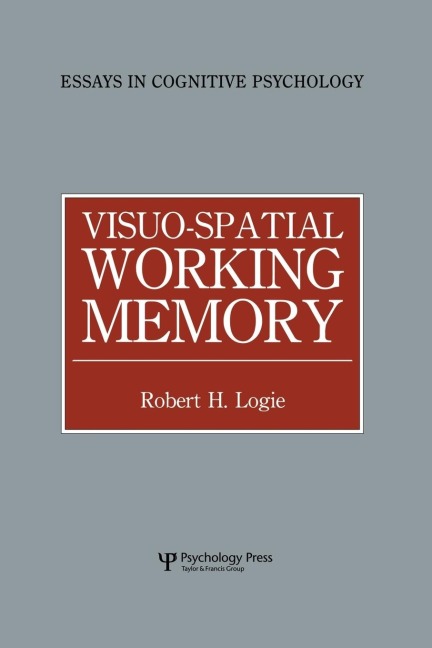
Visuo-spatial Working Memory - Robert H. Logie
-25% su kodu BOOKS
Pristatymas per 15-21 d.d.
30 dienų grąžinimo politika
Representation of the visual and spatial properties of our environment is a pivotal requirement of everyday cognition. We can mentally represent the visual form of objects. We can extract information from several of the senses as to the location of objects in relation to ourselves and to other objects nearby. For some of those objects we can reach out and manipulate them. We can also imagine ourselves manip ... Visas aprašymas
Jums taip pat gali patikti
 TOP
TOP

The Culture Map: Breaking Through the Invisible Boundaries of Global Business
-25% su kodu BOOKS
Yra sandėlyje
TOP

Atomic Habits: An Easy & Proven Way to Build Good Habits & Break Bad Ones
-25% su kodu BOOKS
Yra sandėlyje
TOP

Women Who Run with the Wolves: Myths and Stories of the Wild Woman Archetype
Clarissa Pinkola Estés, Clarissa Pinkola Estes
-25% su kodu BOOKS
Turime sandėlyje pas mūsų tiekėją
 TOP
TOP

Prisoners of Geography: Updated 10th Anniversary Edition: Ten Maps That Tell You Everything You Need To Know About Global Politics
-25% su kodu BOOKS
Turime sandėlyje pas mūsų tiekėją
TOP


Classic Football Shirts
Classic Football Shirts, Rory Smith
-25% su kodu BOOKS
Turime sandėlyje pas mūsų tiekėją
TOP

All about Love: New Visions
-25% su kodu BOOKS
Turime sandėlyje pas mūsų tiekėją
 TOP
TOP

Israel: What Went Wrong?
-25% su kodu BOOKS
Turime sandėlyje pas mūsų tiekėją
TOP
Sapiens: A Brief History of Humankind
-25% su kodu BOOKS
Turime sandėlyje pas mūsų tiekėją
TOP

How Democracies Die
Steven Levitsky, Daniel Ziblatt
-25% su kodu BOOKS
Turime sandėlyje pas mūsų tiekėją
TOP

The Nord Stream Conspiracy: The Inside Story of the Explosions That Shook the World
-25% su kodu BOOKS
Nėra sandėlyje
TOP

The Whole-Brain Child: 12 Revolutionary Strategies to Nurture Your Child's Developing Mind
Daniel J. Siegel, Tina Payne Bryson
-25% su kodu BOOKS
Turime sandėlyje pas mūsų tiekėją
TOP

Everything I Know About Love: Now a Major BBC One Series
-25% su kodu BOOKS
Yra sandėlyje
TOP

Braiding Sweetgrass: Indigenous Wisdom, Scientific Knowledge and the Teachings of Plants
-25% su kodu BOOKS
Turime sandėlyje pas mūsų tiekėją

 TOP
TOP

The Year of Magical Thinking
-25% su kodu BOOKS
Turime sandėlyje pas mūsų tiekėją
TOP

To Kill a Mockingbird. 60th Anniversary Edition
-25% su kodu BOOKS
Yra sandėlyje
TOP

The Testaments: The Sequel to The Handmaid's Tale
-25% su kodu BOOKS
Turime sandėlyje pas mūsų tiekėją
Aprašymas
Representation of the visual and spatial properties of our environment is a pivotal requirement of everyday cognition. We can mentally represent the visual form of objects. We can extract information from several of the senses as to the location of objects in relation to ourselves and to other objects nearby. For some of those objects we can reach out and manipulate them. We can also imagine ourselves manipulating objects in advance of doing so, or even when it would be impossible to do so physically. The problem posed to science is how these cognitive operations are accomplished, and proffered accounts lie in two essentially parallel research endeavours, working memory and imagery. Working memory is thought to pervade everyday cognition, to provide on-line processing and temporary storage, and to update, moment to moment, our representation of the current state of our environment and our interactions with that environment. There is now a strong case for the claims of working memory in the area of phonological and articulatory functions, all of which appear to contribute to everyday activities such as counting, arithmetic, vocabulary acquisition, and some aspects of reading and language comprehension. The claims for visual and spatial working memory functions are less convincing. Most notable has been the assumption that visual and spatial working memory are intimately involved in the generation, retention and manipulations of visual images. There has until recently been little hard evidence to justify that assumption, and the research on visual and spatial working memory has focused on a relatively restricted range of imagery tasks and phenomena. In a more or less independent development, the literature on visual imagery has now amassed a voluminous corpus of data and theory about a wide range of imagery phenomena. Despite this, few books on imagery refer to the concept of working memory in any detail, or specify the nature of the working memory system that might be involved in mental imagery. This essay follows a line of reconciliation and positive critiquing in exploring the possible overlap between mental imagery and working memory. Theoretical development in the book draws on data from both cognitive psychology and cognitive neuropsychology. The aim is to stimulate debate, to address directly a number of assumptions that hitherto have been implicit, and to assess the contribution of the concept of working memory to our understanding of these intriguing core aspects of human cognition.
Daugiau informacijos
| Autorius | Robert H. Logie |
|---|---|
| Leidėjas | Psychology Press |
| Išleidimo metai | 2015 |
| Viršelio tipas | Minkšti viršeliai |
| EAN | 9781138876934 |