
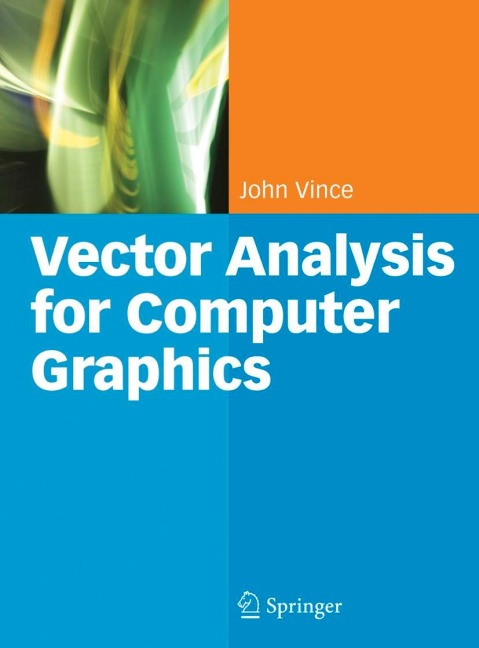
Vector Analysis for Computer Graphics - John Vince
-25% su kodu BOOKS
Pristatymas per 28-34 d.d.
30 dienų grąžinimo politika
In my last book, Geometry for Computer Graphics, I employed a mixture of algebra and vector analysis to prove many of the equations used in computer graphics. At the time, I did not make any distinction between the two methodologies, but slowly it dawned upon me that I had had to discover, for the first time, how to use vector analysis and associated strategies for solving geometric problems. I suppose that ... Visas aprašymas
Jums taip pat gali patikti
 TOP
TOP

Six Not-so-easy Pieces: Einstein's Relativity, Symmetry, and Space-Time
Richard P. Feynman, Robert B. Leighton, Matthew Sands
-25% su kodu BOOKS
Turime sandėlyje pas mūsų tiekėją
TOP

Six Easy Pieces: Essentials of Physics Explained by Its Most Brilliant Teacher
Richard P. Feynman, Robert B. Leighton, Matthew Sands
-25% su kodu BOOKS
Turime sandėlyje pas mūsų tiekėją
TOP

Behave: The Biology of Humans at Our Best and Worst
-25% su kodu BOOKS
Turime sandėlyje pas mūsų tiekėją
TOP
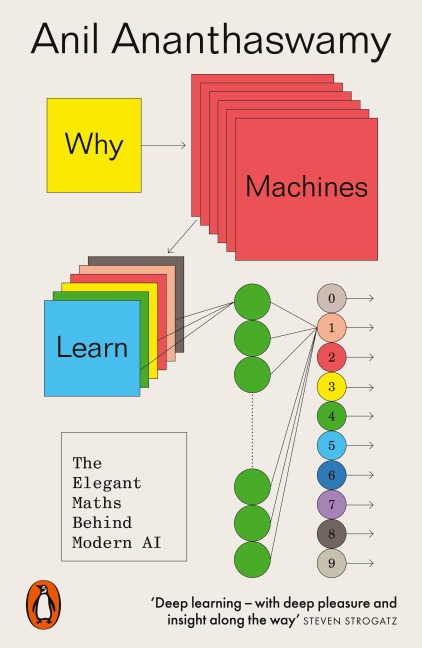
Why Machines Learn: The Elegant Maths Behind Modern AI
-25% su kodu BOOKS
Turime sandėlyje pas mūsų tiekėją
TOP


The Age of Alchemy: How Early Innovators Shaped Modern Chemistry
-25% su kodu BOOKS
Turime sandėlyje pas mūsų tiekėją
TOP

The Secrets of our DNA: How Genetics has Changed the World
-25% su kodu BOOKS
Turime sandėlyje pas mūsų tiekėją
TOP

Why We Sleep: Unlocking the Power of Sleep and Dreams
-25% su kodu BOOKS
Yra sandėlyje
TOP

Factfulness: Ten Reasons We're Wrong About the World--and Why Things Are Better Than You Think
Ola Rosling, Anna Rosling Rönnlund, Hans Rosling
-25% su kodu BOOKS
Turime sandėlyje pas mūsų tiekėją
TOP

Astrophysics for People in a Hurry: Essays on the Universe and Our Place Within It
-25% su kodu BOOKS
Turime sandėlyje pas mūsų tiekėją
TOP

The Rise and Fall of the Dinosaurs: A New History of a Lost World
-25% su kodu BOOKS
Turime sandėlyje pas mūsų tiekėją
TOP

The Rise and Reign of the Mammals: A New History, from the Shadow of the Dinosaurs to Us
-25% su kodu BOOKS
Turime sandėlyje pas mūsų tiekėją
TOP

Determined: The Science of Life Without Free Will
-25% su kodu BOOKS
Turime sandėlyje pas mūsų tiekėją
TOP

Learn Faster, Perform Better: A Musician's Guide to the Neuroscience of Practicing
-25% su kodu BOOKS
Turime sandėlyje pas mūsų tiekėją
TOP

Beyond Inheritance: Our Ever-Mutating Cells and a New Understanding of Health
-25% su kodu BOOKS
Turime sandėlyje pas mūsų tiekėją
TOP

On the Origin of Species
-25% su kodu BOOKS
Turime sandėlyje pas mūsų tiekėją
TOP

The Feynman Lectures on Physics. The New Millennium Edition
Matthew Sands, Robert Leighton, Richard Feynman
-25% su kodu BOOKS
Turime sandėlyje pas mūsų tiekėją
TOP

How to Solve it: A New Aspect of Mathematical Method
-25% su kodu BOOKS
Turime sandėlyje pas mūsų tiekėją
TOP

Thing Explainer: Complicated Stuff in Simple Words
-25% su kodu BOOKS
Turime sandėlyje pas mūsų tiekėją
TOP

Introduction to Quantum Mechanics
Darrell F. Schroeter, David J. Griffiths
-25% su kodu BOOKS
Turime sandėlyje pas mūsų tiekėją
TOP

How Far the Light Reaches: A Life in Ten Sea Creatures
-25% su kodu BOOKS
Turime sandėlyje pas mūsų tiekėją
Aprašymas
In my last book, Geometry for Computer Graphics, I employed a mixture of algebra and vector analysis to prove many of the equations used in computer graphics. At the time, I did not make any distinction between the two methodologies, but slowly it dawned upon me that I had had to discover, for the first time, how to use vector analysis and associated strategies for solving geometric problems. I suppose that mathematicians are taught this as part of their formal mathematical training, but then, I am not a mathematician! After some deliberation, I decided to write a book that would introduce the beginner to the world of vectors and their application to the geometric problems encountered in computer graphics. I accepted the fact that there would be some duplication of formulas between this and my last book; however, this time I would concentrate on explaining how problems are solved. The book contains eleven chapters: The first chapter distinguishes between scalar and vector quantities, which is reasonably straightforward. The second chapter introduces vector repres- tation, starting with Cartesian coordinates and concluding with the role of direction cosines in changes in axial systems. The third chapter explores how the line equation has a natural vector interpretation and how vector analysis is used to resolve a variety of line-related, geometric problems. Chapter 4 repeats Chapter 3 in the context of the plane.
Daugiau informacijos
| Autorius | John Vince |
|---|---|
| Leidėjas | Springer London |
| Išleidimo metai | 2007 |
| Viršelio tipas | Kieti viršeliai |
| EAN | 9781846288036 |