
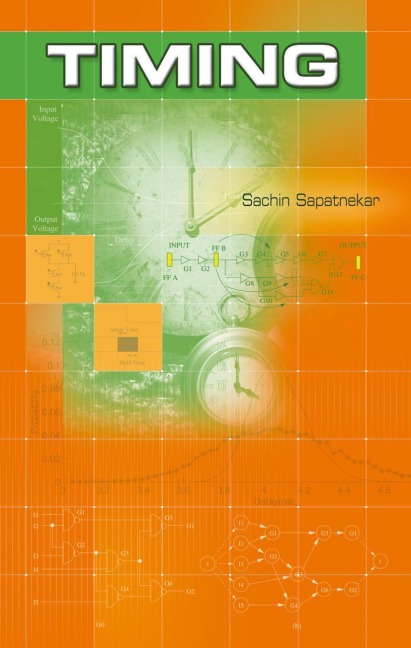
Timing - Sachin Sapatnekar
-25% su kodu BOOKS
Pristatymas per 17-23 d.d.
30 dienų grąžinimo politika
Statistical timing analysis is an area of growing importance in nanometer te- nologies¿ as the uncertainties associated with process and environmental var- tions increase¿ and this chapter has captured some of the major efforts in this area. This remains a very active field of research¿ and there is likely to be a great deal of new research to be found in conferences and journals after this book is publishe ... Visas aprašymas
Jums taip pat gali patikti
 TOP
TOP

The Art of Electronics
-25% su kodu BOOKS
Turime sandėlyje pas mūsų tiekėją
TOP

The Design of Everyday Things
-25% su kodu BOOKS
Turime sandėlyje pas mūsų tiekėją
TOP

If Anyone Builds It, Everyone Dies: The Case Against Superintelligent AI
Eliezer Yudkowsky, Nate Soares
-25% su kodu BOOKS
Turime sandėlyje pas mūsų tiekėją
TOP


We Are Not Machines: The Fight for the Future of Work
-25% su kodu BOOKS
Nėra sandėlyje
TOP
Open Circuits: The Inner Beauty of Electronic Components
Eric Schlaepfer, Windell Oskay
-25% su kodu BOOKS
Turime sandėlyje pas mūsų tiekėją
TOP
Get started with MicroPython on Raspberry Pi Pico: The Official Raspberry Pi Pico Guide
-25% su kodu BOOKS
Turime sandėlyje pas mūsų tiekėją
TOP

Practical Electronics for Inventors
-25% su kodu BOOKS
Turime sandėlyje pas mūsų tiekėją
TOP

Nucleo Boards Programming with the STM32CubeIDE: Hands-on in more than 50 projects
-25% su kodu BOOKS
Turime sandėlyje pas mūsų tiekėją
TOP

Data-Driven Science and Engineering: Machine Learning, Dynamical Systems, and Control
Steven L. Brunton, J. Nathan Kutz
-25% su kodu BOOKS
Turime sandėlyje pas mūsų tiekėją
 TOP
TOP

Fundamentals of Aerodynamics ISE
Christopher Cadou, John D. Anderson
-25% su kodu BOOKS
Turime sandėlyje pas mūsų tiekėją
TOP

Black Holes: The Key to Understanding the Universe
-25% su kodu BOOKS
Turime sandėlyje pas mūsų tiekėją
TOP

KiCad Like A Pro - Fundamentals and Projects: Getting started with the world's best open-source PCB tool
-25% su kodu BOOKS
Turime sandėlyje pas mūsų tiekėją
TOP

Foundations of Flavor: The Noma Guide to Fermentation: Including Step-By-Step Information on Making and Cooking with: Koji, Kombuchas, Shoyus, Misos, Vinegars, Garums, Lacto-Ferments and black Fruits Vegetables
-25% su kodu BOOKS
Turime sandėlyje pas mūsų tiekėją
TOP

Make: Electronics: Learning by Discovery: A hands-on primer for the new electronics enthusiast
-25% su kodu BOOKS
Turime sandėlyje pas mūsų tiekėją
TOP

The Idea Factory: Bell Labs and the Great Age of American Innovation
-25% su kodu BOOKS
Turime sandėlyje pas mūsų tiekėją
TOP

Flowers For Algernon: A Modern Literary Classic
-25% su kodu BOOKS
Turime sandėlyje pas mūsų tiekėją
TOP

Professional SMD Assembly: Practical Low-Cost Methods for Reliable PCB Production
-25% su kodu BOOKS
Turime sandėlyje pas mūsų tiekėją
TOP

Blood in the Machine: The Origins of the Rebellion Against Big Tech
-25% su kodu BOOKS
Turime sandėlyje pas mūsų tiekėją
TOP

Mastering the Arduino Uno R4: Programming and Projects for the Minima and WiFi
-25% su kodu BOOKS
Turime sandėlyje pas mūsų tiekėją
Aprašymas
Statistical timing analysis is an area of growing importance in nanometer te- nologies¿ as the uncertainties associated with process and environmental var- tions increase¿ and this chapter has captured some of the major efforts in this area. This remains a very active field of research¿ and there is likely to be a great deal of new research to be found in conferences and journals after this book is published. In addition to the statistical analysis of combinational circuits¿ a good deal of work has been carried out in analyzing the effect of variations on clock skew. Although we will not treat this subject in this book¿ the reader is referred to [LNPS00¿ HN01¿ JH01¿ ABZ03a] for details. 7 TIMING ANALYSIS FOR SEQUENTIAL CIRCUITS 7.1 INTRODUCTION A general sequential circuit is a network of computational nodes (gates) and memory elements (registers). The computational nodes may be conceptualized as being clustered together in an acyclic network of gates that forms a c- binational logic circuit. A cyclic path in the direction of signal propagation 1 is permitted in the sequential circuit only if it contains at least one register . In general, it is possible to represent any sequential circuit in terms of the schematic shown in Figure 7.1, which has I inputs, O outputs and M registers. The registers outputs feed into the combinational logic which, in turn, feeds the register inputs. Thus, the combinational logic has I + M inputs and O + M outputs.
Daugiau informacijos
| Autorius | Sachin Sapatnekar |
|---|---|
| Leidėjas | Springer US |
| Išleidimo metai | 2004 |
| Viršelio tipas | Kieti viršeliai |
| EAN | 9781402076718 |