
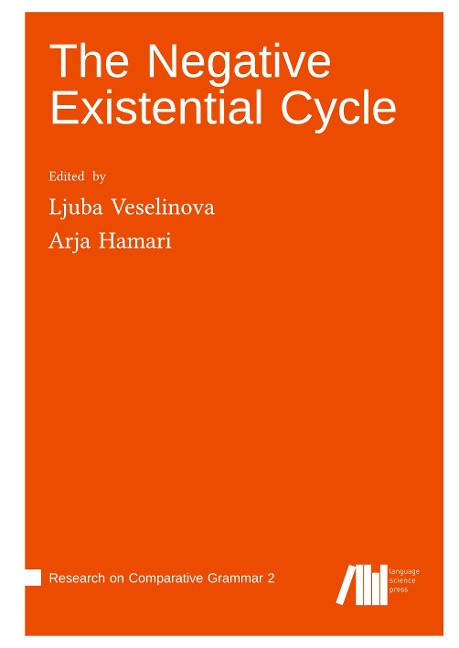
The Negative Existential Cycle -
-25% su kodu BOOKS
Pristatymas per 17-23 d.d.
30 dienų grąžinimo politika
In 1991, William Croft suggested that negative existentials (typically lexical expressions that mean ¿not exist, not have¿) are one possible source for negation markers and gave his hypothesis the name Negative Existential Cycle (NEC). It is a variationist model based on cross-linguistic data. For a good twenty years following its formulation, it was cited at face-value without ever having been tested by (h ... Visas aprašymas
Jums taip pat gali patikti
 TOP
TOP

Technisches Wörterbuch für die Luftfahrt
-25% su kodu BOOKS
Turime sandėlyje pas mūsų tiekėją
TOP
Talk To Me In Korean Workbook - Level 1: New Edition
-25% su kodu BOOKS
Turime sandėlyje pas mūsų tiekėją
TOP
The Elements of Style - Illustrated
-25% su kodu BOOKS
Turime sandėlyje pas mūsų tiekėją
TOP
The Elements of Eloquence: How To Turn the Perfect English Phrase
-25% su kodu BOOKS
Turime sandėlyje pas mūsų tiekėją
TOP

New Sogang Korean 1A Workbook
-25% su kodu BOOKS
Turime sandėlyje pas mūsų tiekėją
TOP

Technisches Wörterbuch für die Luftfahrt: Englisch - Deutsch
-25% su kodu BOOKS
Turime sandėlyje pas mūsų tiekėją
TOP

English File: Upper-Intermediate: Workbook Without Key
Kate Chomacki, Christina Latham-Koenig, Clive Oxenden, Jane Hudson
-25% su kodu BOOKS
Turime sandėlyje pas mūsų tiekėją
TOP

Paperback Oxford English Dictionary
-25% su kodu BOOKS
Turime sandėlyje pas mūsų tiekėją
TOP

Talk To Me In Korean - Level 1
-25% su kodu BOOKS
Turime sandėlyje pas mūsų tiekėją
TOP

Access Band 1: 5. Schuljahr - Wordmaster - Vokabellernbuch
-25% su kodu BOOKS
Turime sandėlyje pas mūsų tiekėją
TOP

Sejong Korean Vocabulary and Grammar 1A
-25% su kodu BOOKS
Turime sandėlyje pas mūsų tiekėją
TOP

Das Oxford Schulwörterbuch A2-B1: Englisch - Deutsch / Deutsch - Englisch
-25% su kodu BOOKS
Turime sandėlyje pas mūsų tiekėją
TOP

Bird by Bird: Some Instructions on Writing and Life
-25% su kodu BOOKS
Turime sandėlyje pas mūsų tiekėją
TOP

How to Talk to Anyone: 92 Little Tricks for Big Success in Relationships
-25% su kodu BOOKS
Yra sandėlyje
TOP

Korean Grammar in Use - Beginning to Intermediate: Free MP3 Audio Download
Jean-myung Ahn, Kyung-ah Lee, Hoo-young Han
-25% su kodu BOOKS
Turime sandėlyje pas mūsų tiekėją
TOP
Sejong Korean Student Book 1A - English Edition: Free MP3 Download
-25% su kodu BOOKS
Turime sandėlyje pas mūsų tiekėją
TOP

Das große Oxford Wörterbuch: Englisch-Deutsch / Deutsch-Englisch - Mit beigelegtem Exam Trainer
-25% su kodu BOOKS
Turime sandėlyje pas mūsų tiekėją
TOP

Sejong Korean Vocabulary and Grammar 1B
-25% su kodu BOOKS
Turime sandėlyje pas mūsų tiekėją
TOP
Sejong Korean Student Book 1B - English Edition: Free MP3 Download
-25% su kodu BOOKS
Turime sandėlyje pas mūsų tiekėją
TOP

King Sejong Institute Practical Korean 1 Beginner: MP3 Audio Download
-25% su kodu BOOKS
Turime sandėlyje pas mūsų tiekėją
Aprašymas
In 1991, William Croft suggested that negative existentials (typically lexical expressions that mean ¿not exist, not have¿) are one possible source for negation markers and gave his hypothesis the name Negative Existential Cycle (NEC). It is a variationist model based on cross-linguistic data. For a good twenty years following its formulation, it was cited at face-value without ever having been tested by (historical)-comparative data. Over the last decade, Ljuba Veselinova has worked on testing the model in a comparative perspective, and this edited volume further expands on her work. The collection presented here features detailed studies of several language families such as Bantu, Chadic and Indo-European. A number of articles focus on the micro-variation and attested historical developments within smaller groups and clusters such as Arabic, Mandarin and Cantonese, and Nanaic. Finally, variation and historical developments in specific languages are discussed for Ancient Hebrew, Ancient Egyptian, Moksha-Mordvin (Uralic), Bashkir (Turkic), Kalmyk (Mongolic), three Pama-Nyungan languages, O¿dam (Southern Uto-Aztecan) and Tacana (Takanan, Amazonian Bolivia). The book is concluded by two chapters devoted to modeling cyclical processes in language change from different theoretical perspectives. Key notions discussed throughout the book include affirmative and negative existential constructions, the expansion of the latter into verbal negation, and subsequently from more specific to more general markers of negation. Nominalizations as well as the uses of negative existentials as standalone negative answers figure among the most frequent pathways whereby negative existentials evolve as general negation markers. The operation of the Negative Existential Cycle appears partly genealogically conditioned, as the cycle is found to iterate regularly within some families but never starts in others, as is the case in Bantu. In addition, other special negation markers such as nominal negators are found to undergo similar processes, i.e. they expand into the verbal domain and thereby develop into more general negation markers. The book provides rich information on a specific path of the evolution of negation, on cyclical processes in language change, and it show-cases the historical-comparative method in a modern setting.
Daugiau informacijos
| Leidėjas | Language Science Press |
|---|---|
| Series | Research on Comparative Grammar 2 |
| Išleidimo metai | 2022 |
| Viršelio tipas | Kieti viršeliai |
| EAN | 9783985540358 |