
The Involvement Load Hypothesis - Zahra Eskandari
-35% su kodu BOOKS
Pristatymas per 12-18 d.d.
30 dienų grąžinimo politika
Hulstijn and Laufer (2001) proposed a motivational-cognitive construct of task-induced involvement to account for variation in effectiveness among different vocabulary building tasks. The construct of involvement is composed of three components: need, search, and evaluation. Each of the three components can be absent or present when processing a word during tasks. They contend that the degree to which an L2 ... Visas aprašymas
Aprašymas
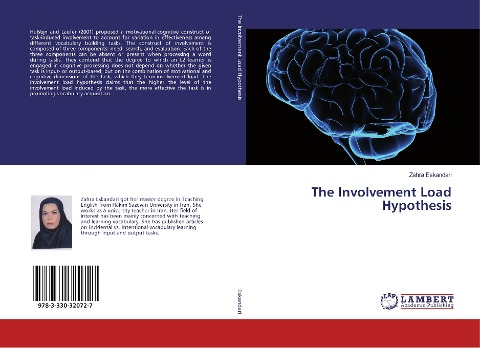
Hulstijn and Laufer (2001) proposed a motivational-cognitive construct of task-induced involvement to account for variation in effectiveness among different vocabulary building tasks. The construct of involvement is composed of three components: need, search, and evaluation. Each of the three components can be absent or present when processing a word during tasks. They contend that the degree to which an L2 learner is engaged in cognitive processing does not depend on whether the given task is input- or output-based, but on the combination of motivational and cognitive dimensions of the task, which they term involvement load. The involvement load hypothesis claims that the higher the level of the involvement load induced by the task, the more effective the task is in promoting vocabulary acquisition.
Daugiau informacijos
| Autorius | Zahra Eskandari |
|---|---|
| Leidėjas | LAP LAMBERT Academic Publishing |
| Išleidimo metai | 2017 |
| Viršelio tipas | Minkšti viršeliai |
| EAN | 9783330320727 |