
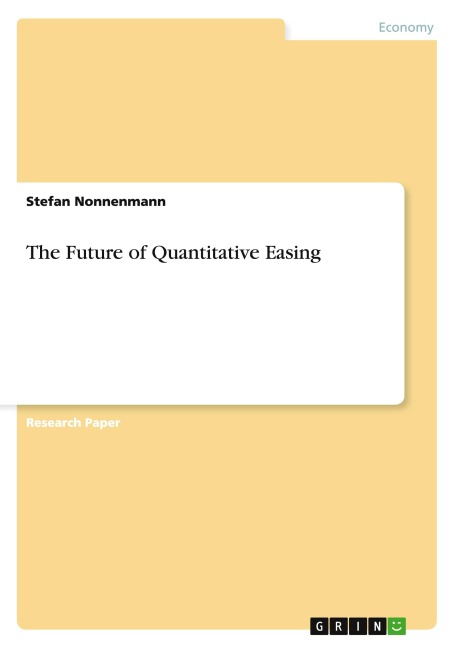
The Future of Quantitative Easing - Stefan Nonnenmann
-35% su kodu BOOKS
Pristatymas per 15-21 d.d.
30 dienų grąžinimo politika
Research Paper (postgraduate) from the year 2014 in the subject Economics - Finance, grade: 95, Alfred University (School of Business), course: Critical Thinking & Problem Framing, language: English, abstract: In response to the financial crisis in 2008, the Federal Reserve implemented all possible monetary policies without significant success. The result was the presentation of the quantitative easing ... Visas aprašymas
Jums taip pat gali patikti

 TOP
TOP

Unreasonable Hospitality: The Remarkable Power of Giving People More Than They Expect
-35% su kodu BOOKS
Turime sandėlyje pas mūsų tiekėją
TOP

Thinking, Fast and Slow
-35% su kodu BOOKS
Turime sandėlyje pas mūsų tiekėją
TOP

Never Split the Difference: Negotiating as if Your Life Depended on It
-35% su kodu BOOKS
Yra sandėlyje
TOP
The 7 Habits of Highly Effective People. 30th Anniversary Edition: Powerful Lessons in Personal Change
Jim Collins, Sean Covey, Stephen R. Covey
-35% su kodu BOOKS
Yra sandėlyje
TOP

Atomic Habits: An Easy & Proven Way to Build Good Habits & Break Bad Ones
-35% su kodu BOOKS
Turime sandėlyje pas mūsų tiekėją
TOP

Radical Candor: Be a Kick-Ass Boss Without Losing Your Humanity
-35% su kodu BOOKS
Turime sandėlyje pas mūsų tiekėją
TOP
Why Nations Fail: The Origins of Power, Prosperity and Poverty
Daron Acemoglu, James A. Robinson
-35% su kodu BOOKS
Turime sandėlyje pas mūsų tiekėją
TOP

Legacy: What The All Blacks Can Teach Us About The Business Of Life
-35% su kodu BOOKS
Turime sandėlyje pas mūsų tiekėją
TOP

The Psychology of Money: Timeless Lessons on Wealth, Greed, and Happiness
-35% su kodu BOOKS
Yra sandėlyje
TOP
Clear Thinking: The Art and Science of Making Better Decisions
-35% su kodu BOOKS
Turime sandėlyje pas mūsų tiekėją
TOP

Vienna: How the City of Ideas Created the Modern World
-35% su kodu BOOKS
Turime sandėlyje pas mūsų tiekėją
TOP

High Output Management
-35% su kodu BOOKS
Turime sandėlyje pas mūsų tiekėją
TOP


The Infinity Machine: Demis Hassabis, DeepMind, and the Quest for Superintelligence
-35% su kodu BOOKS
Turime sandėlyje pas mūsų tiekėją
TOP

1873: The Rothschilds, the First Great Depression, and the Making of the Modern World
-35% su kodu BOOKS
Turime sandėlyje pas mūsų tiekėją
TOP
The Lean Startup: How Today's Entrepreneurs Use Continuous Innovation to Create Radically Successful Businesses
-35% su kodu BOOKS
Yra sandėlyje
TOP
Influence: The Psychology of Persuasion
-35% su kodu BOOKS
Turime sandėlyje pas mūsų tiekėją
TOP

Co-Intelligence: Living and Working with AI
-35% su kodu BOOKS
Turime sandėlyje pas mūsų tiekėją
TOP

The First 90 Days: Proven Straegies for Getting up to Speed faster and smarter
-35% su kodu BOOKS
Turime sandėlyje pas mūsų tiekėją
TOP

Surrounded by Idiots Revised & Expanded Edition: The Four Types of Human Behavior and How to Effectively Communicate with Each in Business (and in Life)
-35% su kodu BOOKS
Turime sandėlyje pas mūsų tiekėją
Aprašymas
Research Paper (postgraduate) from the year 2014 in the subject Economics - Finance, grade: 95, Alfred University (School of Business), course: Critical Thinking & Problem Framing, language: English, abstract: In response to the financial crisis in 2008, the Federal Reserve implemented all possible monetary policies without significant success. The result was the presentation of the quantitative easing (QE) policy, which is a monetary policy where the Federal Reserve purchases mid-to long-term bonds and thus liquidates the market and increases money supply. This paper will illustrate how the quantitative easing benefitted the US economy to overcome the financial crisis. It will illustrate difficulties that QE has not solved like a strong increase in national debt along with US companies¿ hording large amounts of cash abroad, which has made the mission of recovery very difficult for the Federal Reserve. Lastly, it will look at potential solutions besides QE to stabilize the United States economy.
Daugiau informacijos
| Autorius | Stefan Nonnenmann |
|---|---|
| Leidėjas | GRIN Verlag |
| Išleidimo metai | 2014 |
| Viršelio tipas | Minkšti viršeliai |
| EAN | 9783656830672 |