
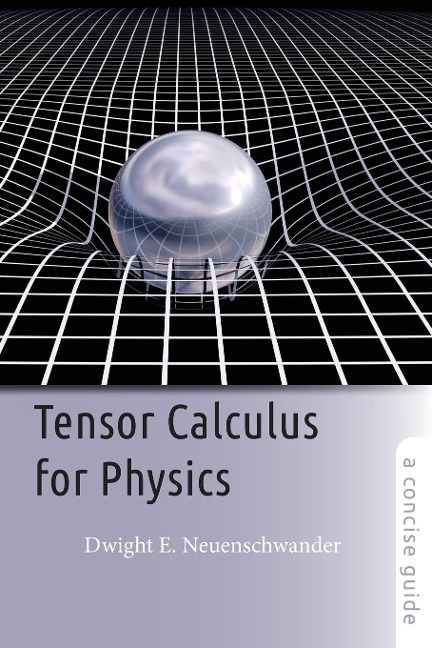
Tensor Calculus for Physics: A Concise Guide - Dwight E. Neuenschwander
-25% su kodu BOOKS
Pristatymas per 31-37 d.d.
30 dienų grąžinimo politika
Understanding tensors is essential for any physics student dealing with phenomena where causes and effects have different directions. A horizontal electric field producing vertical polarization in dielectrics; an unbalanced car wheel wobbling in the vertical plane while spinning about a horizontal axis; an electrostatic field on Earth observed to be a magnetic field by orbiting astronauts-these are some sit ... Visas aprašymas
Jums taip pat gali patikti
 TOP
TOP

Determined: The Science of Life Without Free Will
-25% su kodu BOOKS
Turime sandėlyje pas mūsų tiekėją
TOP

The Rise and Fall of the Dinosaurs: A New History of a Lost World
-25% su kodu BOOKS
Turime sandėlyje pas mūsų tiekėją
TOP

Factfulness: Ten Reasons We're Wrong About the World--and Why Things Are Better Than You Think
Ola Rosling, Anna Rosling Rönnlund, Hans Rosling
-25% su kodu BOOKS
Turime sandėlyje pas mūsų tiekėją
TOP

Biology: A Global Approach, Global Edition
Neil Campbell, Rebecca Orr, Lisa Urry, Peter Minorsky, Michael Cain, Jane Reece, Steven Wasserman
-25% su kodu BOOKS
Turime sandėlyje pas mūsų tiekėją
TOP

Six Not-so-easy Pieces: Einstein's Relativity, Symmetry, and Space-Time
Richard P. Feynman, Robert B. Leighton, Matthew Sands
-25% su kodu BOOKS
Turime sandėlyje pas mūsų tiekėją
TOP

The Light Eaters: How the Unseen World of Plant Intelligence Offers a New Understanding of Life on Earth
-25% su kodu BOOKS
Turime sandėlyje pas mūsų tiekėją
 TOP
TOP


The Age of Alchemy: How Early Innovators Shaped Modern Chemistry
-25% su kodu BOOKS
Turime sandėlyje pas mūsų tiekėją
TOP

The Secrets of our DNA: How Genetics has Changed the World
-25% su kodu BOOKS
Turime sandėlyje pas mūsų tiekėją
TOP

Janeway's Immunobiology
Leslie J. Berg, Kenneth Murphy, Casey Weaver
-25% su kodu BOOKS
Turime sandėlyje pas mūsų tiekėją
TOP

How to Solve it: A New Aspect of Mathematical Method
-25% su kodu BOOKS
Turime sandėlyje pas mūsų tiekėją
TOP

Behave: The Biology of Humans at Our Best and Worst
-25% su kodu BOOKS
Turime sandėlyje pas mūsų tiekėją
TOP

Why We Sleep: Unlocking the Power of Sleep and Dreams
-25% su kodu BOOKS
Yra sandėlyje
TOP
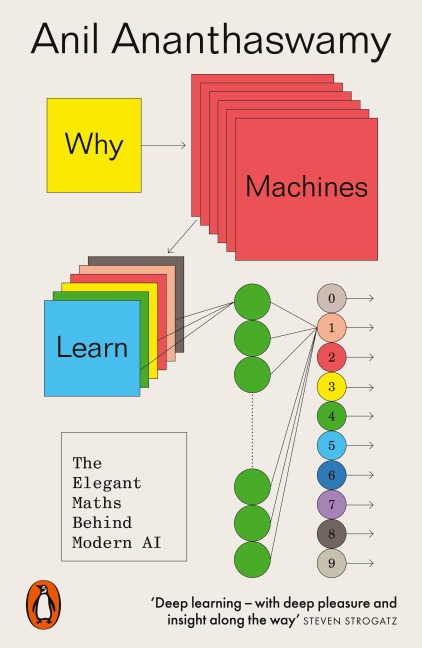
Why Machines Learn: The Elegant Maths Behind Modern AI
-25% su kodu BOOKS
Turime sandėlyje pas mūsų tiekėją
TOP

Six Easy Pieces: Essentials of Physics Explained by Its Most Brilliant Teacher
Richard P. Feynman, Robert B. Leighton, Matthew Sands
-25% su kodu BOOKS
Turime sandėlyje pas mūsų tiekėją
TOP

The Rise and Reign of the Mammals: A New History, from the Shadow of the Dinosaurs to Us
-25% su kodu BOOKS
Turime sandėlyje pas mūsų tiekėją
TOP
Learn Faster, Perform Better: A Musician's Guide to the Neuroscience of Practicing
-25% su kodu BOOKS
Turime sandėlyje pas mūsų tiekėją
TOP
The Brain That Changes Itself: Stories of Personal Triumph from the Frontiers of Brain Science
-25% su kodu BOOKS
Turime sandėlyje pas mūsų tiekėją
TOP

On the Origin of Species
-25% su kodu BOOKS
Turime sandėlyje pas mūsų tiekėją
TOP

Thing Explainer: Complicated Stuff in Simple Words
-25% su kodu BOOKS
Turime sandėlyje pas mūsų tiekėją
Aprašymas
Understanding tensors is essential for any physics student dealing with phenomena where causes and effects have different directions. A horizontal electric field producing vertical polarization in dielectrics; an unbalanced car wheel wobbling in the vertical plane while spinning about a horizontal axis; an electrostatic field on Earth observed to be a magnetic field by orbiting astronauts-these are some situations where physicists employ tensors. But the true beauty of tensors lies in this fact: When coordinates are transformed from one system to another, tensors change according to the same rules as the coordinates. Tensors, therefore, allow for the convenience of coordinates while also transcending them. This makes tensors the gold standard for expressing physical relationships in physics and geometry. Undergraduate physics majors are typically introduced to tensors in special-case applications. For example, in a classical mechanics course, they meet the "inertia tensor," and in electricity and magnetism, they encounter the "polarization tensor." However, this piecemeal approach can set students up for misconceptions when they have to learn about tensors in more advanced physics and mathematics studies (e.g., while enrolled in a graduate-level general relativity course or when studying non-Euclidean geometries in a higher mathematics class). Dwight E. Neuenschwander's Tensor Calculus for Physics is a bottom-up approach that emphasizes motivations before providing definitions. Using a clear, step-by-step approach, the book strives to embed the logic of tensors in contexts that demonstrate why that logic is worth pursuing. It is an ideal companion for courses such as mathematical methods of physics, classical mechanics, electricity and magnetism, and relativity.
Daugiau informacijos
| Autorius | Dwight E. Neuenschwander |
|---|---|
| Leidėjas | Johns Hopkins University Press |
| Išleidimo metai | 2014 |
| Viršelio tipas | Minkšti viršeliai |
| EAN | 9781421415659 |