
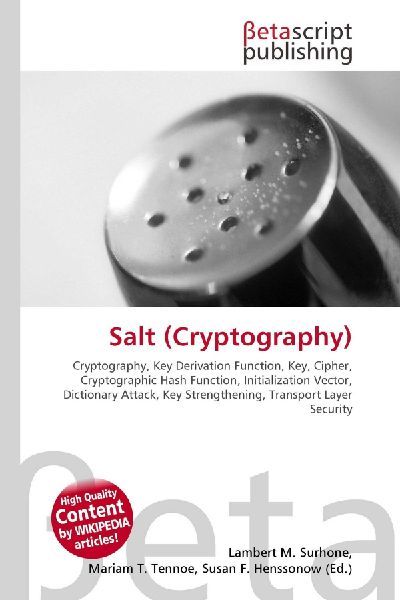
Salt (Cryptography): Cryptography, Key Derivation Function, Key, Cipher, Cryptographic Hash Function, Initialization Vector, Dictionary Attack, Key Strengthening, Transport Layer Security -

-25% su kodu BOOKS
Pristatymas per 15-21 d.d.
30 dienų grąžinimo politika
Please note that the content of this book primarily consists of articles available from Wikipedia or other free sources online. In cryptography, a salt comprises random bits that are used as one of the inputs to a key derivation function. The other input is usually a password or passphrase. The output of the key derivation function is stored as the encrypted version of the password. A salt can also be used ... Visas aprašymas
Jums taip pat gali patikti
 TOP
TOP

Determined: The Science of Life Without Free Will
-25% su kodu BOOKS
Turime sandėlyje pas mūsų tiekėją
TOP

The Light Eaters: How the Unseen World of Plant Intelligence Offers a New Understanding of Life on Earth
-25% su kodu BOOKS
Turime sandėlyje pas mūsų tiekėją
 TOP
TOP

Why We Sleep: Unlocking the Power of Sleep and Dreams
-25% su kodu BOOKS
Yra sandėlyje
TOP
The Rise and Fall of the Dinosaurs: A New History of a Lost World
-25% su kodu BOOKS
Turime sandėlyje pas mūsų tiekėją
TOP

Factfulness: Ten Reasons We're Wrong About the World--and Why Things Are Better Than You Think
Ola Rosling, Anna Rosling Rönnlund, Hans Rosling
-25% su kodu BOOKS
Turime sandėlyje pas mūsų tiekėją
TOP

Biology: A Global Approach, Global Edition
Neil Campbell, Rebecca Orr, Lisa Urry, Peter Minorsky, Michael Cain, Jane Reece, Steven Wasserman
-25% su kodu BOOKS
Turime sandėlyje pas mūsų tiekėją
TOP

Six Not-so-easy Pieces: Einstein's Relativity, Symmetry, and Space-Time
Richard P. Feynman, Robert B. Leighton, Matthew Sands
-25% su kodu BOOKS
Turime sandėlyje pas mūsų tiekėją
TOP

Entangled Life: How Fungi Make Our Worlds, Change Our Minds and Shape Our Futures
-25% su kodu BOOKS
Turime sandėlyje pas mūsų tiekėją
TOP
The Age of Alchemy: How Early Innovators Shaped Modern Chemistry
-25% su kodu BOOKS
Turime sandėlyje pas mūsų tiekėją
TOP
The Secrets of our DNA: How Genetics has Changed the World
-25% su kodu BOOKS
Turime sandėlyje pas mūsų tiekėją
TOP

Janeway's Immunobiology
Leslie J. Berg, Kenneth Murphy, Casey Weaver
-25% su kodu BOOKS
Turime sandėlyje pas mūsų tiekėją
TOP
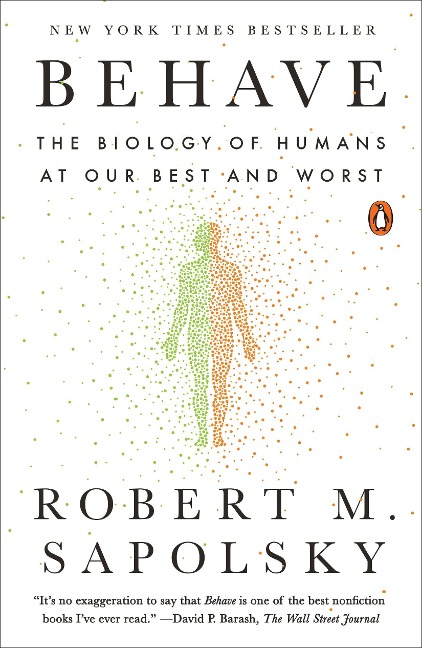
Behave: The Biology of Humans at Our Best and Worst
-25% su kodu BOOKS
Turime sandėlyje pas mūsų tiekėją
TOP
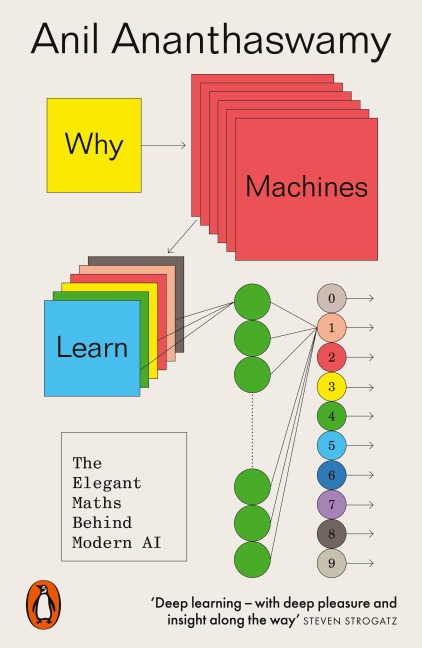
Why Machines Learn: The Elegant Maths Behind Modern AI
-25% su kodu BOOKS
Turime sandėlyje pas mūsų tiekėją
TOP

The Feynman Lectures on Physics. The New Millennium Edition
Matthew Sands, Robert Leighton, Richard Feynman
-25% su kodu BOOKS
Turime sandėlyje pas mūsų tiekėją
TOP
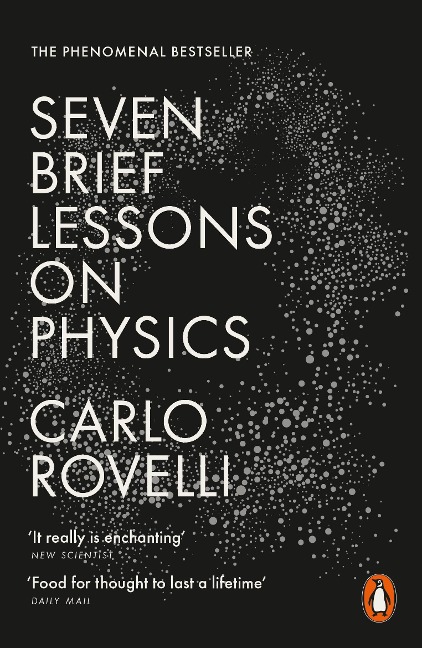
Seven Brief Lessons on Physics
-25% su kodu BOOKS
Turime sandėlyje pas mūsų tiekėją
TOP

Life As No One Knows It: The Physics of Life's Emergence
-25% su kodu BOOKS
Turime sandėlyje pas mūsų tiekėją
TOP
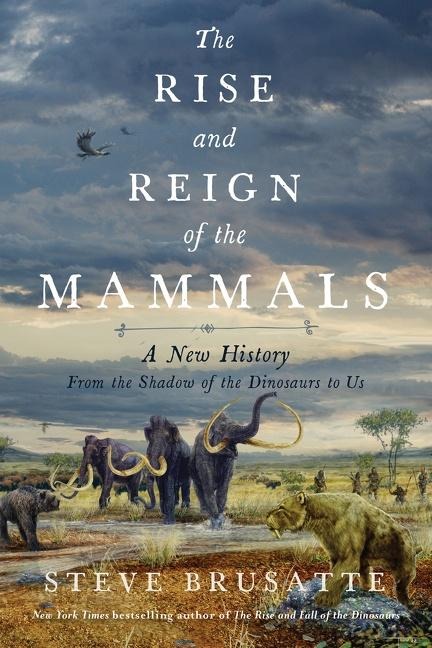
The Rise and Reign of the Mammals: A New History, from the Shadow of the Dinosaurs to Us
-25% su kodu BOOKS
Turime sandėlyje pas mūsų tiekėją
TOP
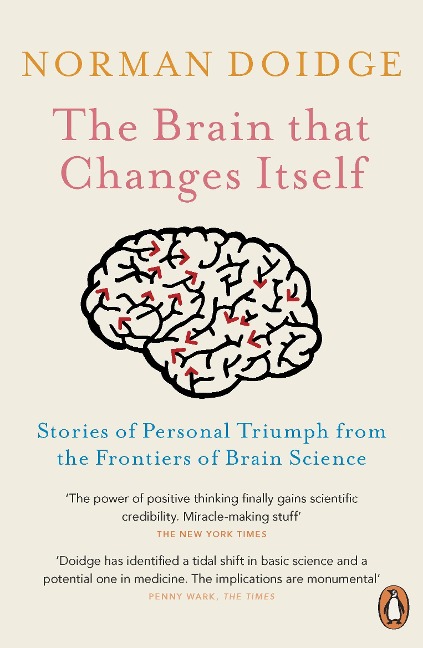
The Brain That Changes Itself: Stories of Personal Triumph from the Frontiers of Brain Science
-25% su kodu BOOKS
Turime sandėlyje pas mūsų tiekėją
TOP

How to Solve it: A New Aspect of Mathematical Method
-25% su kodu BOOKS
Turime sandėlyje pas mūsų tiekėją
Aprašymas
Daugiau informacijos
| Leidėjas | OmniScriptum |
|---|---|
| Išleidimo metai | 2026 |
| Viršelio tipas | Minkšti viršeliai |
| EAN | 9786130351540 |