
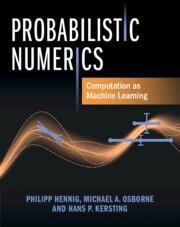
Probabilistic Numerics: Computation as Machine Learning - Philipp Hennig,Michael A. Osborne,Hans P. Kersting
-25% su kodu BOOKS
Pristatymas per 31-37 d.d.
30 dienų grąžinimo politika
Probabilistic numerical computation formalises the connection between machine learning and applied mathematics. Numerical algorithms approximate intractable quantities from computable ones. They estimate integrals from evaluations of the integrand, or the path of a dynamical system described by differential equations from evaluations of the vector field. In other words, they infer a latent quantity from dat ... Visas aprašymas
Jums taip pat gali patikti
 TOP
TOP
Biology: A Global Approach, Global Edition
Neil Campbell, Rebecca Orr, Lisa Urry, Peter Minorsky, Michael Cain, Jane Reece, Steven Wasserman
-25% su kodu BOOKS
Turime sandėlyje pas mūsų tiekėją
TOP

Six Not-so-easy Pieces: Einstein's Relativity, Symmetry, and Space-Time
Richard P. Feynman, Robert B. Leighton, Matthew Sands
-25% su kodu BOOKS
Turime sandėlyje pas mūsų tiekėją
TOP

Determined: The Science of Life Without Free Will
-25% su kodu BOOKS
Turime sandėlyje pas mūsų tiekėją
 TOP
TOP

The Age of Alchemy: How Early Innovators Shaped Modern Chemistry
-25% su kodu BOOKS
Turime sandėlyje pas mūsų tiekėją
TOP
The Secrets of our DNA: How Genetics has Changed the World
-25% su kodu BOOKS
Turime sandėlyje pas mūsų tiekėją
TOP

Janeway's Immunobiology
Leslie J. Berg, Kenneth Murphy, Casey Weaver
-25% su kodu BOOKS
Turime sandėlyje pas mūsų tiekėją
TOP

How to Solve it: A New Aspect of Mathematical Method
-25% su kodu BOOKS
Turime sandėlyje pas mūsų tiekėją
TOP
Why We Sleep: Unlocking the Power of Sleep and Dreams
-25% su kodu BOOKS
Yra sandėlyje
TOP

The Light Eaters: How the Unseen World of Plant Intelligence Offers a New Understanding of Life on Earth
-25% su kodu BOOKS
Turime sandėlyje pas mūsų tiekėją
TOP

Six Easy Pieces: Essentials of Physics Explained by Its Most Brilliant Teacher
Richard P. Feynman, Robert B. Leighton, Matthew Sands
-25% su kodu BOOKS
Turime sandėlyje pas mūsų tiekėją
TOP
The Rise and Fall of the Dinosaurs: A New History of a Lost World
-25% su kodu BOOKS
Turime sandėlyje pas mūsų tiekėją
TOP
The Rise and Reign of the Mammals: A New History, from the Shadow of the Dinosaurs to Us
-25% su kodu BOOKS
Turime sandėlyje pas mūsų tiekėją
TOP
Learn Faster, Perform Better: A Musician's Guide to the Neuroscience of Practicing
-25% su kodu BOOKS
Turime sandėlyje pas mūsų tiekėją
TOP
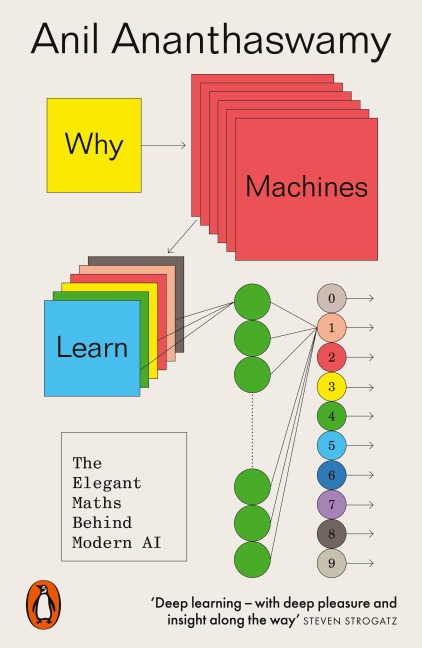
Why Machines Learn: The Elegant Maths Behind Modern AI
-25% su kodu BOOKS
Turime sandėlyje pas mūsų tiekėją
TOP

Beyond Inheritance: Our Ever-Mutating Cells and a New Understanding of Health
-25% su kodu BOOKS
Turime sandėlyje pas mūsų tiekėją
TOP
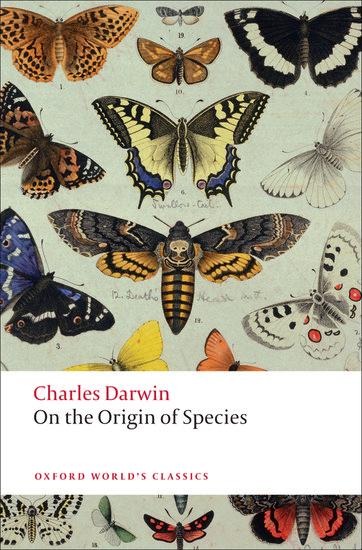
On the Origin of Species
-25% su kodu BOOKS
Turime sandėlyje pas mūsų tiekėją
TOP

The Feynman Lectures on Physics. The New Millennium Edition
Matthew Sands, Robert Leighton, Richard Feynman
-25% su kodu BOOKS
Turime sandėlyje pas mūsų tiekėją
TOP

Thing Explainer: Complicated Stuff in Simple Words
-25% su kodu BOOKS
Turime sandėlyje pas mūsų tiekėją
TOP
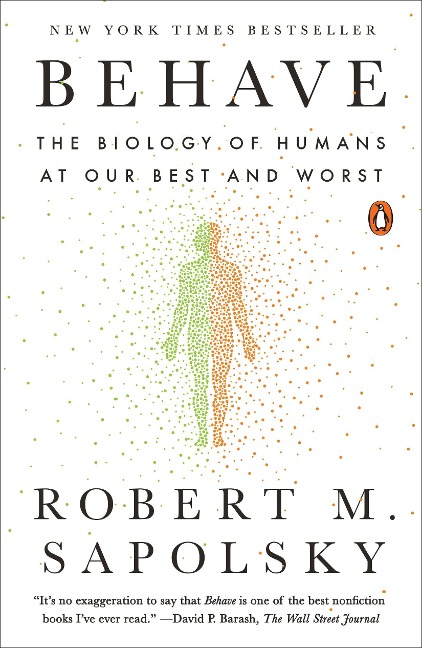
Behave: The Biology of Humans at Our Best and Worst
-25% su kodu BOOKS
Turime sandėlyje pas mūsų tiekėją
Aprašymas
Probabilistic numerical computation formalises the connection between machine learning and applied mathematics. Numerical algorithms approximate intractable quantities from computable ones. They estimate integrals from evaluations of the integrand, or the path of a dynamical system described by differential equations from evaluations of the vector field. In other words, they infer a latent quantity from data. This book shows that it is thus formally possible to think of computational routines as learning machines, and to use the notion of Bayesian inference to build more flexible, efficient, or customised algorithms for computation. The text caters for Masters' and PhD students, as well as postgraduate researchers in artificial intelligence, computer science, statistics, and applied mathematics. Extensive background material is provided along with a wealth of figures, worked examples, and exercises (with solutions) to develop intuition.
Daugiau informacijos
| Autorius | Philipp Hennig, Michael A. Osborne, Hans P. Kersting |
|---|---|
| Leidėjas | Cambridge University Press |
| Išleidimo metai | 2022 |
| Viršelio tipas | Kieti viršeliai |
| EAN | 9781107163447 |