
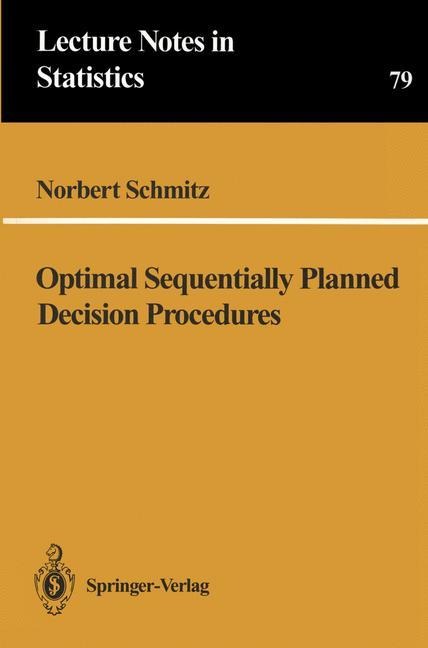
Optimal Sequentially Planned Decision Procedures - Norbert Schmitz
-35% su kodu BOOKS
Pristatymas per 12-18 d.d.
30 dienų grąžinimo politika
Learning from experience, making decisions on the basis of the available information, and proceeding step by step to a desired goal are fundamental behavioural qualities of human beings. Nevertheless, it was not until the early 1940's that such a statistical theory - namely Sequential Analysis - was created, which allows us to investigate this kind of behaviour in a precise manner. A. Wald's famous sequenti ... Visas aprašymas
Jums taip pat gali patikti
 TOP
TOP

Determined: The Science of Life Without Free Will
-35% su kodu BOOKS
Turime sandėlyje pas mūsų tiekėją
TOP

The Light Eaters: How the Unseen World of Plant Intelligence Offers a New Understanding of Life on Earth
-35% su kodu BOOKS
Turime sandėlyje pas mūsų tiekėją
 TOP
TOP
Why We Sleep: Unlocking the Power of Sleep and Dreams
-35% su kodu BOOKS
Yra sandėlyje
TOP
The Rise and Fall of the Dinosaurs: A New History of a Lost World
-35% su kodu BOOKS
Turime sandėlyje pas mūsų tiekėją
TOP

Biology: A Global Approach, Global Edition
Neil Campbell, Rebecca Orr, Lisa Urry, Peter Minorsky, Michael Cain, Jane Reece, Steven Wasserman
-35% su kodu BOOKS
Turime sandėlyje pas mūsų tiekėją
TOP

Six Not-so-easy Pieces: Einstein's Relativity, Symmetry, and Space-Time
Richard P. Feynman, Robert B. Leighton, Matthew Sands
-35% su kodu BOOKS
Turime sandėlyje pas mūsų tiekėją
TOP
Explaining AuDHD: The expert-led guide to Autism and ADHD Co-concurrence
-35% su kodu BOOKS
Turime sandėlyje pas mūsų tiekėją
TOP


The Age of Alchemy: How Early Innovators Shaped Modern Chemistry
-35% su kodu BOOKS
Turime sandėlyje pas mūsų tiekėją
TOP

The Secrets of our DNA: How Genetics has Changed the World
-35% su kodu BOOKS
Turime sandėlyje pas mūsų tiekėją
TOP
Factfulness: Ten Reasons We're Wrong About the World--and Why Things Are Better Than You Think
Ola Rosling, Anna Rosling Rönnlund, Hans Rosling
-35% su kodu BOOKS
Turime sandėlyje pas mūsų tiekėją
TOP
Why Machines Learn: The Elegant Maths Behind Modern AI
-35% su kodu BOOKS
Turime sandėlyje pas mūsų tiekėją
TOP
Seven Brief Lessons on Physics
-35% su kodu BOOKS
Turime sandėlyje pas mūsų tiekėją
TOP

Entangled Life: How Fungi Make Our Worlds, Change Our Minds and Shape Our Futures
-35% su kodu BOOKS
Turime sandėlyje pas mūsų tiekėją
TOP

Life As No One Knows It: The Physics of Life's Emergence
-35% su kodu BOOKS
Turime sandėlyje pas mūsų tiekėją
TOP
The Rise and Reign of the Mammals: A New History, from the Shadow of the Dinosaurs to Us
-35% su kodu BOOKS
Turime sandėlyje pas mūsų tiekėją
TOP
Learn Faster, Perform Better: A Musician's Guide to the Neuroscience of Practicing
-35% su kodu BOOKS
Turime sandėlyje pas mūsų tiekėją
TOP

Janeway's Immunobiology
Leslie J. Berg, Kenneth Murphy, Casey Weaver
-35% su kodu BOOKS
Turime sandėlyje pas mūsų tiekėją
TOP

The Road to Reality: A Complete Guide to the Laws of the Universe
-35% su kodu BOOKS
Turime sandėlyje pas mūsų tiekėją
TOP
The Brain That Changes Itself: Stories of Personal Triumph from the Frontiers of Brain Science
-35% su kodu BOOKS
Turime sandėlyje pas mūsų tiekėją
Aprašymas
Learning from experience, making decisions on the basis of the available information, and proceeding step by step to a desired goal are fundamental behavioural qualities of human beings. Nevertheless, it was not until the early 1940's that such a statistical theory - namely Sequential Analysis - was created, which allows us to investigate this kind of behaviour in a precise manner. A. Wald's famous sequential probability ratio test (SPRT; see example (1.8» turned out to have an enormous influence on the development of this theory. On the one hand, Wald's fundamental monograph "Sequential Analysis" ([Wa]*) is essentially centered around this test. On the other hand, important properties of the SPRT - e.g. Bayes optimality, minimax-properties, "uniform" optimality with respect to expected sample sizes - gave rise to the development of a general statistical decision theory. As a conse quence, the SPRT's played a dominating role in the further development of sequential analysis and, more generally, in theoretical statistics.
Daugiau informacijos
| Autorius | Norbert Schmitz |
|---|---|
| Leidėjas | Springer US |
| Series | Lecture Notes in Statistics |
| Išleidimo metai | 1992 |
| Viršelio tipas | Minkšti viršeliai |
| EAN | 9780387979083 |