
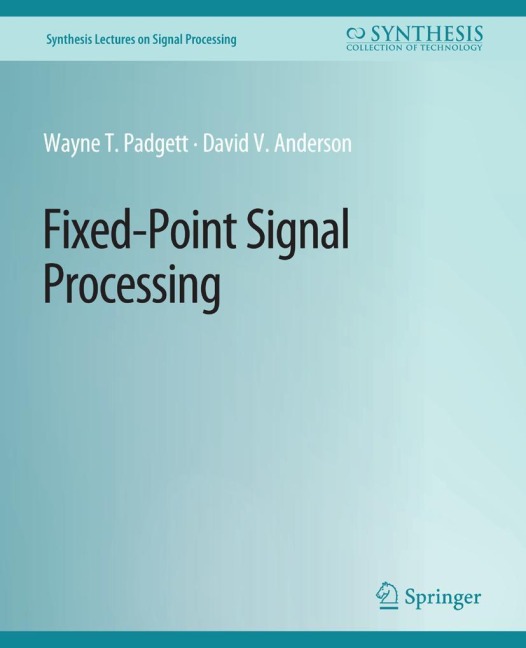
Fixed-Point Signal Processing - David Anderson,Wayne Padgett
-25% su kodu BOOKS
Pristatymas per 12-18 d.d.
30 dienų grąžinimo politika
This book is intended to fill the gap between the ""ideal precision"" digital signal processing (DSP) that is widely taught, and the limited precision implementation skills that are commonly required in fixed-point processors and field programmable gate arrays (FPGAs). These skills are often neglected at the university level, particularly for undergraduates. We have attempted to create a resource both for a ... Visas aprašymas
Jums taip pat gali patikti
 TOP
TOP

The Art of Electronics
-25% su kodu BOOKS
Turime sandėlyje pas mūsų tiekėją
TOP
If Anyone Builds It, Everyone Dies: The Case Against Superintelligent AI
Eliezer Yudkowsky, Nate Soares
-25% su kodu BOOKS
Turime sandėlyje pas mūsų tiekėją
TOP

The Design of Everyday Things
-25% su kodu BOOKS
Turime sandėlyje pas mūsų tiekėją
TOP
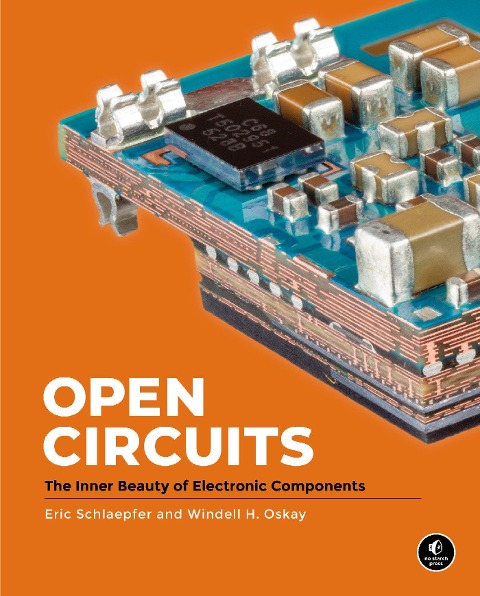
Open Circuits: The Inner Beauty of Electronic Components
Eric Schlaepfer, Windell Oskay
-25% su kodu BOOKS
Turime sandėlyje pas mūsų tiekėją
TOP
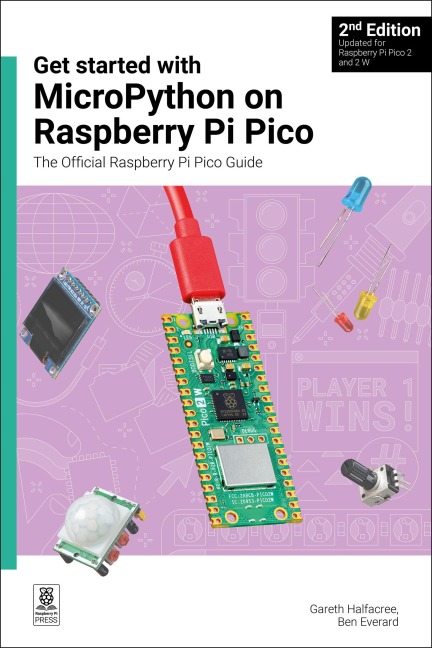
Get started with MicroPython on Raspberry Pi Pico: The Official Raspberry Pi Pico Guide
-25% su kodu BOOKS
Turime sandėlyje pas mūsų tiekėją
TOP

Nucleo Boards Programming with the STM32CubeIDE: Hands-on in more than 50 projects
-25% su kodu BOOKS
Turime sandėlyje pas mūsų tiekėją
TOP

Practical Electronics for Inventors
-25% su kodu BOOKS
Turime sandėlyje pas mūsų tiekėją
TOP

Data-Driven Science and Engineering: Machine Learning, Dynamical Systems, and Control
Steven L. Brunton, J. Nathan Kutz
-25% su kodu BOOKS
Turime sandėlyje pas mūsų tiekėją
TOP

Fundamentals of Aerodynamics ISE
Christopher Cadou, John D. Anderson
-25% su kodu BOOKS
Turime sandėlyje pas mūsų tiekėją
TOP

Black Holes: The Key to Understanding the Universe
-25% su kodu BOOKS
Turime sandėlyje pas mūsų tiekėją
TOP

KiCad Like A Pro - Fundamentals and Projects: Getting started with the world's best open-source PCB tool
-25% su kodu BOOKS
Turime sandėlyje pas mūsų tiekėją
TOP

Foundations of Flavor: The Noma Guide to Fermentation: Including Step-By-Step Information on Making and Cooking with: Koji, Kombuchas, Shoyus, Misos, Vinegars, Garums, Lacto-Ferments and black Fruits Vegetables
-25% su kodu BOOKS
Turime sandėlyje pas mūsų tiekėją
TOP

Make: Electronics: Learning by Discovery: A hands-on primer for the new electronics enthusiast
-25% su kodu BOOKS
Turime sandėlyje pas mūsų tiekėją
TOP

The Idea Factory: Bell Labs and the Great Age of American Innovation
-25% su kodu BOOKS
Turime sandėlyje pas mūsų tiekėją
TOP

Flowers For Algernon: A Modern Literary Classic
-25% su kodu BOOKS
Turime sandėlyje pas mūsų tiekėją
TOP


Professional SMD Assembly: Practical Low-Cost Methods for Reliable PCB Production
-25% su kodu BOOKS
Turime sandėlyje pas mūsų tiekėją
TOP

Blood in the Machine: The Origins of the Rebellion Against Big Tech
-25% su kodu BOOKS
Turime sandėlyje pas mūsų tiekėją
TOP

Mastering the Arduino Uno R4: Programming and Projects for the Minima and WiFi
-25% su kodu BOOKS
Turime sandėlyje pas mūsų tiekėją
TOP

Learning the Art of Electronics: A Hands-On Lab Course
Thomas C. Hayes, Paul Horowitz, David Abrams
-25% su kodu BOOKS
Turime sandėlyje pas mūsų tiekėją
TOP

AI 2041: Ten Visions for Our Future
-25% su kodu BOOKS
Turime sandėlyje pas mūsų tiekėją
Aprašymas
This book is intended to fill the gap between the ""ideal precision"" digital signal processing (DSP) that is widely taught, and the limited precision implementation skills that are commonly required in fixed-point processors and field programmable gate arrays (FPGAs). These skills are often neglected at the university level, particularly for undergraduates. We have attempted to create a resource both for a DSP elective course and for the practicing engineer with a need to understand fixed-point implementation. Although we assume a background in DSP, Chapter 2 contains a review of basic theory and Chapter 3 reviews random processes to support the noise model of quantization error. Chapter 4 details the binary arithmetic that underlies fixed-point processors and then introduces fractional format for binary numbers. Chapter 5 covers the noise model for quantization error and the effects of coefficient quantization in filters. Because of the numerical sensitivity of IIR filters, they are used extensively as an example system in both Chapters 5 and 6. Fortunately, the principles of dealing with limited precision can be applied to a wide variety of numerically sensitive systems, not just IIR filters. Chapter 6 discusses the problems of product roundoff error and various methods of scaling to avoid overflow. Chapter 7 discusses limit cycle effects and a few common methods for minimizing them. There are a number of simple exercises integrated into the text to allow you to test your understanding. Answers to the exercises are included in the footnotes. A number of MATLAB examples are provided in the text. They generally assume access to the Fixed-Point Toolbox. If you lack access to this software, consider either purchasing or requesting an evaluation license from The Mathworks. The code listed in the text and other helpful MATLAB code is also available at http://www.morganclaypool.com/page/padgett and http://www.rose-hulman.edu/padgett/fpsp. You will also find MATLAB exercises designed to demonstrate each of the four types of error discussed in Chapters 5 and 6. Simulink examples are also provided on the web site. Table of Contents: Getting Started / DSP Concepts / Random Processes and Noise / Fixed Point Numbers / Quantization Effects: Data and Coefficients / Quantization Effects - Round-Off Noise and Overflow / Limit Cycles
Daugiau informacijos
| Autorius | David Anderson, Wayne Padgett |
|---|---|
| Leidėjas | Springer Nature Switzerland |
| Series | Synthesis Lectures on Signal Processing |
| Išleidimo metai | 2009 |
| Viršelio tipas | Minkšti viršeliai |
| EAN | 9783031014055 |