
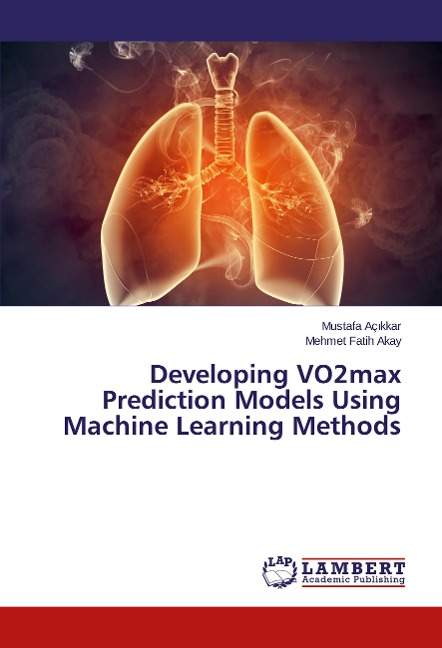
Developing VO2max Prediction Models Using Machine Learning Methods - Mustafa Aç¿kkar,Mehmet Fatih Akay
-25% su kodu BOOKS
Pristatymas per 12-18 d.d.
30 dienų grąžinimo politika
The purpose of this work is to develop VO2max prediction models by using non-exercise, submaximal and hybrid variables by using Support Vector Machines (SVM), Multi-layer Feed-forward Artificial Neural Networks (MFANN) and Multiple Linear Regression (MLR) on different data sets. Using 10-fold cross validation on four different data sets, the performance of prediction models has been evaluated by calculating ... Visas aprašymas
Jums taip pat gali patikti
 TOP
TOP

Gödel, Escher, Bach: An Eternal Golden Braid
-25% su kodu BOOKS
Turime sandėlyje pas mūsų tiekėją
TOP
AI Engineering: Building Applications with Foundation Models
-25% su kodu BOOKS
Turime sandėlyje pas mūsų tiekėją
TOP
Empire of AI: Dreams and Nightmares in Sam Altman's OpenAI
-25% su kodu BOOKS
Turime sandėlyje pas mūsų tiekėją
TOP
The Pragmatic Programmer: journey to mastery, 20th Anniversary Edition, 2/e: your journey to mastery, 20th Anniversary Edition
-25% su kodu BOOKS
Turime sandėlyje pas mūsų tiekėją
TOP


The Rust Programming Language
Steve Klabnik, Carol Nichols, Chris Krycho
-25% su kodu BOOKS
Turime sandėlyje pas mūsų tiekėją
TOP

How Linux Works: What Every Superuser Should Know
-25% su kodu BOOKS
Turime sandėlyje pas mūsų tiekėją
TOP
How To Think About AI: A Guide For The Perplexed
-25% su kodu BOOKS
Turime sandėlyje pas mūsų tiekėją
TOP

The Art of Game Design: A Book of Lenses
-25% su kodu BOOKS
Turime sandėlyje pas mūsų tiekėją
TOP
Python Crash Course: A Hands-On, Project-Based Introduction to Programming
-25% su kodu BOOKS
Turime sandėlyje pas mūsų tiekėją
TOP

CompTIA Security+ Certification Kit: Exam SY0-701
-25% su kodu BOOKS
Turime sandėlyje pas mūsų tiekėją
TOP
Automate the Boring Stuff with Python
-25% su kodu BOOKS
Turime sandėlyje pas mūsų tiekėją
TOP
Fundamentals of Software Architecture: A Modern Engineering Approach
-25% su kodu BOOKS
Turime sandėlyje pas mūsų tiekėją
TOP
Speak Data: Artists, Scientists, Thinkers, and Dreamers on How We Live Our Lives in Numbers
-25% su kodu BOOKS
Turime sandėlyje pas mūsų tiekėją
TOP

Hacking: The Art of Exploitation
-25% su kodu BOOKS
Turime sandėlyje pas mūsų tiekėją
TOP

Hackers. 25th Anniversary Edition: Heroes of the Computer Revolution
-25% su kodu BOOKS
Turime sandėlyje pas mūsų tiekėją
TOP

Deep Learning
Ian Goodfellow, Yoshua Bengio, Aaron Courville
-25% su kodu BOOKS
Turime sandėlyje pas mūsų tiekėją
TOP

Proofs from THE BOOK
Martin Aigner, Günter M. Ziegler
-25% su kodu BOOKS
Turime sandėlyje pas mūsų tiekėją
TOP
Mathematics for Machine Learning
Cheng Soon Ong, A. Aldo Faisal, Marc Peter Deisenroth
-25% su kodu BOOKS
Turime sandėlyje pas mūsų tiekėją
TOP
Artificial Intelligence: A Modern Approach, Global Edition
-25% su kodu BOOKS
Turime sandėlyje pas mūsų tiekėją
TOP

Heavy Wizardry 101: Shellcodes, Backdoors, Droppers, and Worms
-25% su kodu BOOKS
Nėra sandėlyje
Aprašymas
The purpose of this work is to develop VO2max prediction models by using non-exercise, submaximal and hybrid variables by using Support Vector Machines (SVM), Multi-layer Feed-forward Artificial Neural Networks (MFANN) and Multiple Linear Regression (MLR) on different data sets. Using 10-fold cross validation on four different data sets, the performance of prediction models has been evaluated by calculating their multiple correlation coefficients (R¿s) and standard error of estimates (SEE¿s). The results show that SVM-based VO2max prediction models perform better (i.e. yield lower SEE¿s and higher R¿s) than the prediction models developed by MFANN and MLR. We also propose a new approach based on the elimination of irrelevant samples during the training phase for improving the performance of SVM and MFANN models for prediction of VO2max. The performance of the proposed approach has been compared with the two widely used outlier detection algorithms. The results show that the improved SVM-based and MFANN-based VO2max prediction models yield noticeable decrements in error rates compared to that of regular and outlier-based SVM and MFANN VO2max prediction models.
Daugiau informacijos
| Autorius | Mustafa Aç¿kkar, Mehmet Fatih Akay |
|---|---|
| Leidėjas | LAP LAMBERT Academic Publishing |
| Išleidimo metai | 2015 |
| Viršelio tipas | Minkšti viršeliai |
| EAN | 9783659806148 |