
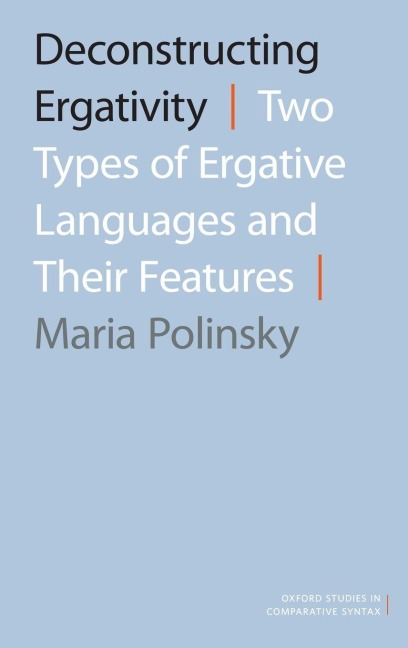
Deconstructing Ergativity - Polinsky
-25% su kodu BOOKS
Pristatymas per 17-23 d.d.
30 dienų grąžinimo politika
Nominative-accusative and ergative are two common alignment types found across languages. In the former type, the subject of an intransitive verb and the subject of a transitive verb are expressed the same way, and differently from the object of a transitive. In ergative languages, the subject of an intransitive and the object of a transitive appear in the same form, the absolutive, and the transitive subje ... Visas aprašymas
Aprašymas
Nominative-accusative and ergative are two common alignment types found across languages. In the former type, the subject of an intransitive verb and the subject of a transitive verb are expressed the same way, and differently from the object of a transitive. In ergative languages, the subject of an intransitive and the object of a transitive appear in the same form, the absolutive, and the transitive subject has a special, ergative, form. Ergative languages often follow very different patterns, thus evading a uniform description and analysis. A simple explanation for that has to do with the idea that ergative languages, much as their nominative-accusative counterparts, do not form a uniform class. In this book, Maria Polinsky argues that ergative languages instantiate two main types, the one where the ergative subject is a prepositional phrase (PP-ergatives) and the one with a noun-phrase ergative. Each type is internally consistent and is characterized by a set of well-defined properties.
The book begins with an analysis of syntactic ergativity, which as Polinsky argues, is a manifestation of the PP-ergative type. Polinsky discusses diagnostic properties that define PPs in general and then goes to show that a subset of ergative expressions fit the profile of PPs. Several alternative analyses have been proposed to account for syntactic ergativity; the book presents and outlines these analyses and offers further considerations in support of the PP-ergativity approach. The book then discusses the second type, DP-ergative languages, and traces the diachronic connection between the two types.
The book includes two chapters illustrating paradigm PP-ergative and DP-ergative languages: Tongan and Tsez. The data used in these descriptions come from Polinsky's original fieldwork hence presenting new empirical facts from both languages.
Daugiau informacijos
| Autorius | Polinsky |
|---|---|
| Leidėjas | Oxford University Press |
| Series | Academic |
| Išleidimo metai | 2011 |
| Viršelio tipas | Kieti viršeliai |
| EAN | 9780190256586 |