
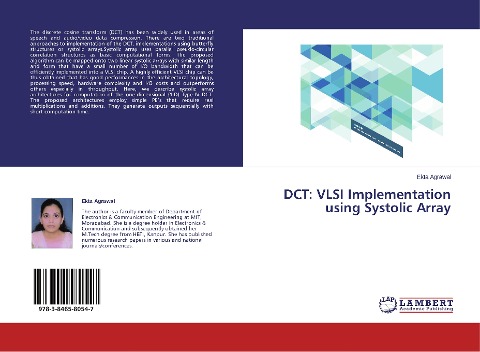
DCT: VLSI Implementation using Systolic Array - Ekta Agrawal
-25% su kodu BOOKS
Pristatymas per 12-18 d.d.
30 dienų grąžinimo politika
The discrete cosine transform (DCT) has been widely used in areas of speech and audio/video data compression. There are two traditional approaches to implementation of the DCT, implementations using butterfly structures or systolic arrays.Systolic array uses parallel pseudo-circular correlation structures as basic computational forms. The proposed algorithm can be mapped onto two linear systolic arrays with ... Visas aprašymas
Jums taip pat gali patikti
 TOP
TOP

The Art of Electronics
-25% su kodu BOOKS
Turime sandėlyje pas mūsų tiekėją
TOP

The Idea Factory: Bell Labs and the Great Age of American Innovation
-25% su kodu BOOKS
Turime sandėlyje pas mūsų tiekėją
TOP

The Design of Everyday Things
-25% su kodu BOOKS
Turime sandėlyje pas mūsų tiekėją
TOP
Practical Electronics for Inventors
-25% su kodu BOOKS
Turime sandėlyje pas mūsų tiekėją
TOP

Flowers For Algernon: A Modern Literary Classic
-25% su kodu BOOKS
Turime sandėlyje pas mūsų tiekėją
TOP

Foundations of Flavor: The Noma Guide to Fermentation: Including Step-By-Step Information on Making and Cooking with: Koji, Kombuchas, Shoyus, Misos, Vinegars, Garums, Lacto-Ferments and black Fruits Vegetables
-25% su kodu BOOKS
Turime sandėlyje pas mūsų tiekėją
TOP

Nucleo Boards Programming with the STM32CubeIDE: Hands-on in more than 50 projects
-25% su kodu BOOKS
Turime sandėlyje pas mūsų tiekėją
TOP
Make: Electronics: Learning by Discovery: A hands-on primer for the new electronics enthusiast
-25% su kodu BOOKS
Turime sandėlyje pas mūsų tiekėją
TOP

Blood in the Machine: The Origins of the Rebellion Against Big Tech
-25% su kodu BOOKS
Turime sandėlyje pas mūsų tiekėją
TOP
Data-Driven Science and Engineering: Machine Learning, Dynamical Systems, and Control
Steven L. Brunton, J. Nathan Kutz
-25% su kodu BOOKS
Turime sandėlyje pas mūsų tiekėją
TOP
Open Circuits: The Inner Beauty of Electronic Components
Eric Schlaepfer, Windell Oskay
-25% su kodu BOOKS
Turime sandėlyje pas mūsų tiekėją
TOP
INCOSE Systems Engineering Handbook
-25% su kodu BOOKS
Turime sandėlyje pas mūsų tiekėją
TOP
Fundamentals of Aerodynamics ISE
Christopher Cadou, John D. Anderson
-25% su kodu BOOKS
Turime sandėlyje pas mūsų tiekėją
TOP

Black Holes: The Key to Understanding the Universe
-25% su kodu BOOKS
Turime sandėlyje pas mūsų tiekėją
TOP
KiCad Like A Pro - Fundamentals and Projects: Getting started with the world's best open-source PCB tool
-25% su kodu BOOKS
Turime sandėlyje pas mūsų tiekėją
TOP
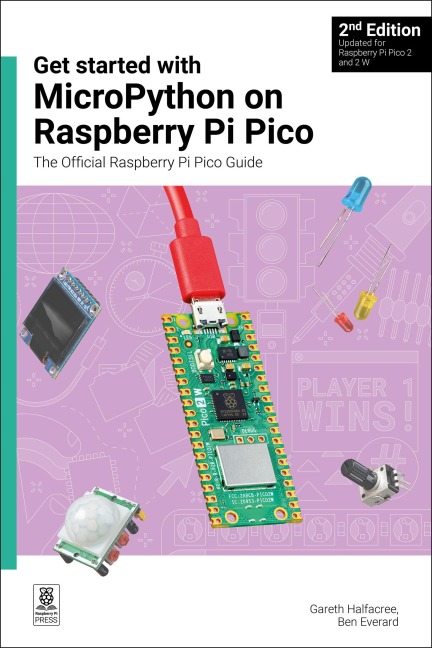
Get started with MicroPython on Raspberry Pi Pico: The Official Raspberry Pi Pico Guide
-25% su kodu BOOKS
Turime sandėlyje pas mūsų tiekėją
TOP
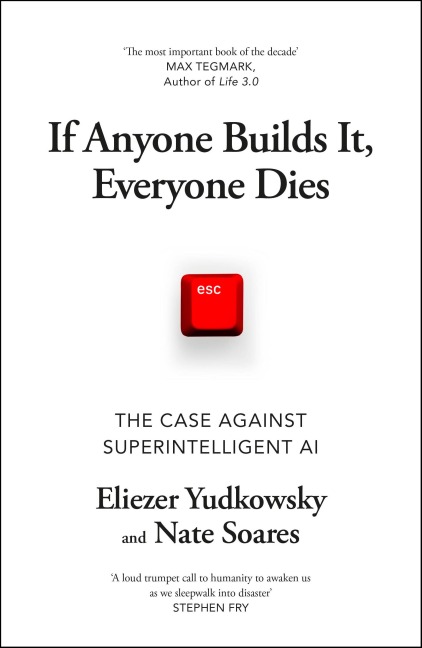
If Anyone Builds It, Everyone Dies: The Case Against Superintelligent AI
Eliezer Yudkowsky, Nate Soares
-25% su kodu BOOKS
Turime sandėlyje pas mūsų tiekėją
TOP


We Are Not Machines: The Fight for the Future of Work
-25% su kodu BOOKS
Turime sandėlyje pas mūsų tiekėją
TOP
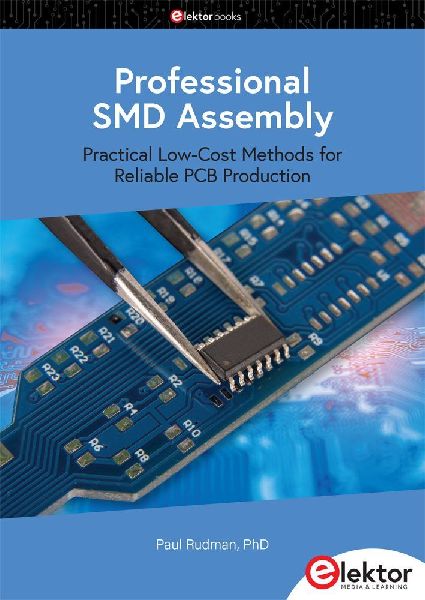
Professional SMD Assembly: Practical Low-Cost Methods for Reliable PCB Production
-25% su kodu BOOKS
Turime sandėlyje pas mūsų tiekėją
Aprašymas
The discrete cosine transform (DCT) has been widely used in areas of speech and audio/video data compression. There are two traditional approaches to implementation of the DCT, implementations using butterfly structures or systolic arrays.Systolic array uses parallel pseudo-circular correlation structures as basic computational forms. The proposed algorithm can be mapped onto two linear systolic arrays with similar length and form that have a small number of I/O bandwidth that can be efficiently implemented into a VLSI chip. A highly efficient VLSI chip can be thus obtained that has good performances in the architectural topology, processing speed, hardware complexity and I/O costs and outperforms others especially in throughput. Here, we describe systolic array architectures for computation of the one-dimensional (1-D) Type-IV DCT. The proposed architectures employ simple PE¿s that require real multiplications and additions. They generate outputs sequentially with short computation time.
Daugiau informacijos
| Autorius | Ekta Agrawal |
|---|---|
| Leidėjas | LAP LAMBERT Academic Publishing |
| Išleidimo metai | 2014 |
| Viršelio tipas | Minkšti viršeliai |
| EAN | 9783846580547 |